
-
Boycotts and the Jordanian Economy
Boycotts in Jordan
As the days in Amman are getting cooler, I find increasingly pleasant to stroll around the city. Small shops, restaurants, and the occasional supermarket are complemented with street vendors and the unmistakable jingle of the pick-up trucks which deliver water and gas. But there is something missing. Something, I could not place my finger on until I was standing in front of a large commercial building with the logos of McDonalds and Starbucks outside. The building, I quickly noticed, was entirely empty. Still, it looked as if it has not been like this for long. I started to pay attention to large chains and discovered that almost all of them had closed. The only thing I could find was a small Carrefour close to where I live which was full of products but no customers in sight. I already had a suspicion what the cause of the closing of so many large chains might be, and it was confirmed in a conversation with a friend. He was born in Jordan, but his family is originally from Palestine, a story that he shares with many people who live in Amman. He explained to me that most of the large chains like McDonalds or Starbucks are being boycotted. McDonalds for instance gave out free meals for IDF soldiers in Israel. My friend also pointed out companies which I did not notice are being boycotted. Pepsi for instance was a widely available product until the end of 2023 where boycotts started to show their impact. Now you will struggle to find it anywhere in Jordan. Pepsi products have been replaced by Matrix, a Jordanian soft drink producer which brings us to the topic I want to discuss today. Boycotts in Jordan have been more effective than I ever thought they could be. By effective I do not mean that companies changed their behaviour because of them, for that Jordan is unfortunately too small of a market. Instead, I mean that Jordanians have done what is within their power. They boycotted companies tied to the Israeli occupation of Palestinian land so consistently that they are forced to close shop in Jordan. Something like that would be unimaginable in Europe where boycotts tend to put a small dent into companies’ profits at most. As a consequence of boycotting some international companies, Jordanian consumers have sought alternative products, often Jordanian ones, such as Matrix soft drinks.The Impact of Boycotts on Domestic Markets
There is a lot of theory that explores the ethical, political and economic dimensions of boycotts. Something that I could not find however is how boycotts affect domestic markets not of the boycotted country, but of the one that is doing the boycotting. I think that is a consequence of most of this research being conducted in countries which never experienced boycotts that were so effective that companies had to close shop. I do not want to get in a complex statistical analysis here, mainly because I do not have the skills or data for that, yet. Instead, I want to outline some key factors to consider when discussing the impact of boycotts on domestic markets using Jordan as a case study.The first factor I already touched upon is the substitution of boycotted products with alternative ones. The key question here is, if consumers switch to domestically produced goods or simply to another foreign producer. If the latter is the case, then there will hardly be any change in the domestic markets. If, people do switch to domestic brands, for example with Pepsi being substituted with Matrix, domestic demand for these goods increases. The likely impact of this development would be higher employment, profits which are invested in the domestic markets and higher taxes paid to the Jordanian government. All of these would be positive effects for Jordan. This effect points to two other factors, employment and profits as well as where they are invested. As McDonalds and Starbucks are closing a key question is if enough consumption shifts to other companies so that they employ the equivalent amount of those who lost their jobs at the boycotted companies. If that is not the case than the total disposable income in Jordan decreases which would have negative effects for its economy. The last factor is profits and investment. If boycotted goods are substituted with domestic ones, then profits will stay in the domestic market. A rising demand for these goods will also create an incentive to invest these profits into the domestic market. This again would be coupled with additional employment. These factors are just the surface, and it is hard to guess how big the impact of boycotts on domestic markets is without data and statistical analysis. Still, I found it an interesting facete of boycotts and one that, in my opinion, deserves more attention.
Final Remarks
I want to conclude by pointing you to the Boycott, Divest, and Sanction movement (BDS). The movement originated in the BLM movement and is now mostly concerned with ending the support of companies which profit from the Israeli occupation of Palestinian land. In the recent past it has also been applied to environmental protection and climate justice. Regardless of the cause, you will find plenty of information online, which explain how and why BDS works. Something that I particularly like is that websites and apps often provide short and clear outlines why they think a company should be boycotted and what this company should do if it wants boycotters to buy their products again. In addition, they let you take pictures or scan Barcodes of products in the supermarket to quickly find out if you should buy them or not. It is an easy way to make a small difference, and I invite you to become part of the movement. -
Evaluation and Monitoring in NGOs and Aid Organizations
Introduction
Although I have only worked in an NGO for three weeks, I have already noticed a key issue which has been reinforced by conversations with people who work in NGOs and aid organisations. The issue is evaluation and monitoring which aims to improve the overall performance of aid organizations and enable donors to make informed decisions about where to put their money. During my Bachelor programme I had already engaged with this issue from time to time on an academic level. I thought that if these issues are common knowledge, or at the very least academic knowledge, then aid organisations should be in the process of addressing them, right? The short answer is no.(I know in my last post I said I will try to keep posts shorter and less theoretical but this did not work out with this one. If you have limited time or are less interested in the analysis of the issue you can jump straight to the summary of criticism and read from there.)
Limits of Output and Performance-based Evaluation
How limited the evaluation in aid organisations is, became clear to me in two conversations. The first one was in a restaurant in Amman, where I was talking to a friend who has been working in major aid organisations for several years. After some small talk and ordering food, I asked how the organisation she currently works for, approaches evaluation and monitoring. She said that it moved from output to performance-based evaluation and considered that to be sufficient to ensure a high quality of projects. Output based evaluation is the easiest but also the least reliable way of doing evaluations. The idea is that the quality of a project is measured by the numbers it produces. Consider the example of a workshop on female empowerment and confidence. To assess the quality of the workshop, the duration of the course and the number of participants would be measured. A long workshop with a high turnout would be considered of high quality. It is however possible that the participants are disempowered and feel less confident after the workshop, yet the output-based evaluation could still consider it to be high quality because a lot of women showed up. The next level of evaluation is the performance based one. It still measures the number of people participating but puts a focus on whether the goals of the workshop have been achieved. My friend outlined to me that participants are often given a survey before and after the workshop which asks them about what they learned and how they feel. The results are then compared to the goal of the project and if they match, the project was of high quality according to the performance-based evaluation. She added that sometimes participants and beneficiaries are invited again up to a year later to evaluate long term impact.It is obvious that performance-based evaluation is better than the simple output-based one but there are two key problems. First is the question whether the participants are good in assessing whether they benefitted from a project or not. For simplicity’s sake let us assume that they can do so for now. Then the second issue is that the person who organizes the project is the same also gathers the data and conducts the performance-based evaluation. This creates an obvious conflict of interest. If I organize a project, I want it to be successful and potentially my job depends on my projects being successful. Thus, I will at the very least be subconsciously biased when creating a performance-based evaluation. Worst case I will consciously conduct the evaluation in a way that is bound to give me better results or simply falsify and misinterpret data. Either way bad projects might get funding again and again because the person who conducts them is put in a position where they benefit from doing so.
Time, Money, and Evaluations
The issue became even clearer when I was discussing the same issue with a colleague in the office. I asked how the organization we work for conducts evaluation. She explained to me that this depends a lot on who is providing the funding. Some donor organizations simply require an output-based evaluation, but most require a performance-based one, again conducted by the person who is organizing the project. When I asked her why they do not always conduct at least a performance-based evaluation she replied that this takes additional time and effort which is unaccounted for in the budget that a donor who only requires an output-based evaluation is providing. This, in general seems to be a big problem. Proper evaluation takes time and money. NGO’s and NPO’s tend to have little of both and prefer to spend it on projects rather than evaluation. The graph below illustrates this the trade-off between using resources on evaluation instead of the projects themselves, working with the assumption that there is a limited amount divided between the two. The trajectory is how I would expect it too look but and the numbers are entirely made up. They only serve to illustrate the point that there is an optimal allocation of resources between the projects themselves and evaluation and monitoring. In the case of this Graph, it is around the 30% mark. Before this point, evaluation improves projects and the allocation of funds to an extent where it offsets the fewer resources available for the projects. After the 30% mark any additional money spent on evaluation would be better spent on the projects themselves if the goal is to improve the overall performance of aid.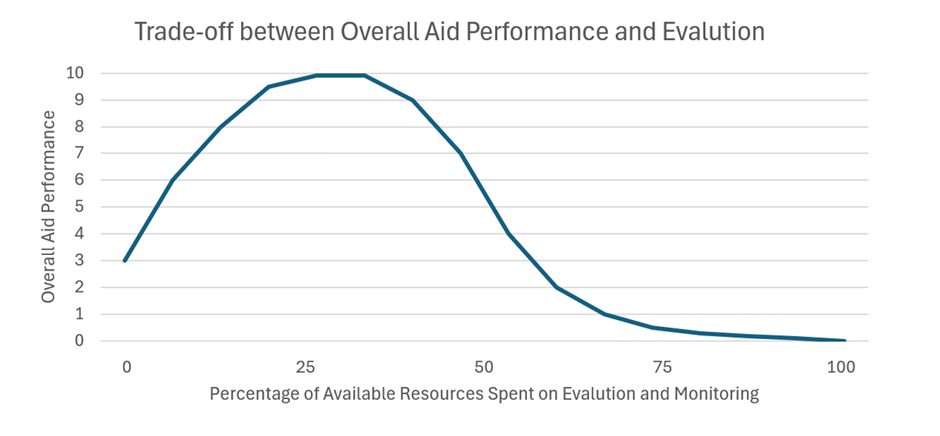
In big projects part of the funding is intended for independent evaluation and monitoring. By big projects I mean ones that costs millions and are often funded by states. Apart from hiring independent evaluation, which is done at the end of the project, they also conduct monitoring. Monitoring means to assess the quality of a project while it is being conducted and propose improvements that can be immediately implemented. Since there are significant funds allocated to evaluation and monitoring and it is conducted by an independent organization the quality is high. There are some issues, however. First, of course is the cost. Smaller organizations will find it impossible to conduct evaluation and monitoring of a similar quality. This leads to the second issue. If big projects rely on smaller organizations to realize them these small projects will lily provide unreliable evaluations of their small-scale projects. Even good monitoring and evaluation upper levels of organisation will not be reliable if the sources of information are not.
Short Summary of Criticism
To summarize what I outlined so far, there is several levels of evaluation and monitoring which aid organizations use to assess the quality of their projects. The core idea is that by measuring the impact of projects well, resources can be directed to them which should improve the overall quality of aid. Output-based evaluations is the first and simplest way to measure impact. It mainly considers the number of people who receive aid but not the quality. Thus, it could consider a project with a high turnout, but which does the opposite of what it intended as successful. It is a crude and inaccurate way to measure performance. As a response to these issues aid organizations started to conduct performance-based evaluations. These measure not only turnout but also if the project achieved its goals, typically through surveys, completed by the beneficiaries. The key problem with this approach is that the evaluation is conducted by the people who organized the project which leads to a clear conflict of interest. The quality of any evaluation can be improved by having an independent agent conduct it, however that is expensive and tends to be possible only for projects with large funding. There is also monitoring which is conducted while the project is implemented and enables feedback loops that can improve the project before it is finished. Again, this is better if done independently and it is probably the most expensive since it is conducted throughout the project.Independent Monitoring and Private-Sector Methods (Outlook)
This all is not to say that we should not donate to or support aid organizations. Instead, this aims to give some ideas for improving the quality of projects that NGOs and aid organizations organize. Given the previous criticism I see two solutions. The first one is straight forward and hinges on two questions. First, can the overall quality of aid and NGO work be improved if more money is spent on evaluation. If the answer to the first question is yes, then the second one is how much money should be spent on evaluation. Conducting evaluations costs money which is then not available to realize more projects. At some point there is too much money put into evaluation and too little into realizing the projects and the overall performance of NGO and aid performance. It is a balance to be struck between spending enough money on evaluation to ensure the overall quality of aid while not spending too much to the point where many projects cannot be realized because the money is spent on evaluation. To improve evaluation, an independent monitoring and evaluation NGO might be beneficial. It will solve the issue of conflict of interest and could secure its own funding so that it can provide its service for free to smaller organizations. From my research so far, I was not able to find an organization like this, so I invite you to research this further and give it a shot.The other way to improve overall performance by improving evaluation and monitoring is to introduce methods from the private sector. There are two keyways in which performance is evaluated and monitored in the private sector. The first is by the consumer who can choose not to buy a product or buy an alternative one. The consumer tends to have little insight into the inner workings of the producer, but they can test the final product and buy it or not. This is a way of evaluating the quality of a good, because if people consider it low quality, they will not buy it, and it will disappear from the market. This is difficult to realize in the context of aid because the beneficiaries often cannot choose between aid providers. A trend that is picking up in aid organizations right now is to consider them not as beneficiaries but as clients which shifts the relation between the two. A client has a position of power from which they can, for example claim that the service they were promised was not provided and can demand compensation. A beneficiary cannot do that. How this works in practice takes some more thinking on my side but I think it is an interesting change in paradigm to improve aid. The other way in which methods from the private sector can improve the evaluation is by imaging donors as investors. A company is required to provide information about the performance of the company and its inner working. They all have significant influence on the direction of the company. In the case of aid organisations donors receive little to no information if their contribution achieved or changed anything. If they were informed about the impact of their donations, they would likely start to focus their donations (or investments) into the most successful projects. The return on “investments” into aid organisations would not be dividends but instead the aid that these organisations can provide with your money.
I know I promised in the last post that I want to change my content towards shorter and less theoretical discussions, and I failed both goals in this text. So, I want to reward the fact that you manged to read this far by finishing with an out-of-the-box idea to keep this fun. If we consider doners more as investors and dividends as the aid that the aid organisations can provide with your money, then what could be a way to simulate the stock exchange? I think it would be an interesting concept if by donating once or on a regular basis to an aid organization, doners could receive shares in it. If shares are limited, then the value of them will depend on demand. As mentioned before the dividends for aid organization is not money but the aid that they can provide. Thus, the better the aid that an organization can provide per dollar they receive the, the higher the dividend is. Following the free-market rationale the higher the dividends the higher the demand for the shares and thus the value increases. Maybe you are starting to see the benefit of this now. Imagine you buy a share in UNICEF now for 50$ and in the following two years UNICEF’s performance improves significantly. The demand for UNICEF shares thus increases because their “dividends” are increasing. Consequently, the share that you bought for 50$ is now worth 75$ due to increased demand. So, if you sell it now, you could make 25$ by selling the share, not accounting for inflation. This system could ensure additional funding for aid but now donors have a monetary incentive to invest in organizations which they expect to perform well. Money would be directed to well performing organizations which would be another way of evaluating their quality because there is money in it now, which tends to improve the quality of evaluation. This idea needs some more thought of course but still I think it is quite intriguing and I might explore it in the future.
-
A New Start
After a long time of not posting anything, I have decided to breath some life back into this blog meant for creative and sometimes naïve ideas and why there might be merit in believing in them. In the past I have posted my ideas and provided some arguments why they might be a reasonable analysis of the past and present or an outlook for the future. The posts have been theoretical, long, and often far away from the life that you and I are living. This is what I seek to change now that I am reviving this, Blog.
With this new start, I will put the focus on the beauty of ideas, rather than trying the impossible task of elaborating them in every detail. At the same time, I will turn them into stories of discovery, connected to the environment and people through which my ideas emerge and take shape. I hope this will make them easier to understand and more relatable. In addition, I believe that apart from making the reading experience more fun, it will also add depth to the points I seek to draw your attention to. To know in which context an idea emerges and through which interaction it takes shape highlights that whether it is politics or astro-physics, ideas and arguments are always connected to the context in which they from. Accepting and engaging with this idea should improve the overall quality of the posts I will share with you in the future.
I will finish this revival with some practicalities. Frist, I want to warn you that I am experimenting with writing short stories in which I explore new ideas in a creative fashion. I am not sure yet when the first of these will appear, but I aim to have a mix of the theoretical and narrative based texts in the future. I will also experiment with writing pieces that I do not know if I agree with or not. This is not to be the devils advocate but instead it is a consequence of avoiding the impossibility of thinking every idea through to its last. In the past this has prevented me from sharing some of my thoughts here. I am never certain that what I write here is “true” or “good”, but I will make it explicit if I am experimenting with an idea which I do not know whether I can stand behind or not. I am always looking forward to your comments to get some outside opinions and inspiration to rethink old ideas or explore new ones. Lastly, to motivate myself to write more, I will try to post every second Friday. I think that you benefit from this regularity as much as I do and hope you find the time to read the new post over weekend. It is exciting to revive my Blog and I am looking forward to embarking on this new journey together.
-
Some Thoughts on Climate Justice
This is paper I have written for university. I have expanded it a bit further and changed a few parts. It has a bit more existing theory compared to usual posts but it is good to engage with them and both theories I present here are quite recent and popular. Have been quite busy these days but there are couple of really interesting ideas coming up in the next few Posts.
Introduction
What is climate justice? The term climate justice has become one of the most frequent words people use to describe how we should approach the issue of ecological destruction and climate change. It is generally accepted to combine sustainability and environmental justice as well as social justice. There are however many different understandings of climate justice and no coherent philosophical justification for it. To employ it properly we therefore need a justification and conceptualization of climate justice. We have to figure out the “why” and “what” for climate justice.
Although there are plenty of ways to approach this issue, I will rely on probably the most influential author in modern political philosophy, John Rawls. His theory on justice offers principles that justify most features of modern welfare states and has reignited the discussions on contract theory and political philosophy in general. In his work Rawls however barely explores the implications of his justice system on a global scale and its consequences for climate and environment.
After quickly explaining core features of Rawls theory, I will use it to develop and justify a new conceptualization of climate justice which will give us two main principles to act on. To get there I will first solve the issue of conflicting ideas of justice and then integrate ideas of both generational and global justice to arrive at the principles.
Rawls theory
Rawls theory is far to big to cover in its entirety for this paper and I will therefore only explain some key features here. Rawls considers the social construct to be the main subject of justice for his theory since it influences and shapes the perception of justice within society. To achieve a perception of justice we must assume the original position. This is done through the veil of ignorance, a thought experiment in which we forget all our economic and social positions. The idea is that we can only determine principles for a just society if we do not know where in this society, we will find ourselves. We must forget our social statuses. Slavery would be a clear feature of an unjust society since no person would support it if they would not know whether they end up as slave or slave owner. Rawls derives two main principles from the original position for a just society.
- Liberty Principle: Equal basic rights and liberties for everyone
- Difference Principle:
- Redistribution where those worst off receive most,
- which is attached to positions and offices open to all
Rawls theory expanded
Now that we understand the issue of the term climate justice and some core features of Rawls theory, we can get to the expansion of Rawls theory. Based on the original position and the veil of ignorance I will first develop a federal understanding of justice which will enable us to think of climate justice as an issue requiring global justice principle, while other domains of justice remain limited to a particular society. Then the idea of generational justice will be used to justify principles from the original position that tackle the issue of sustainability. Lastly, I will discuss the society we are born in as a status we must forget behind the veil of ignorance and the implications of that. In combination with Rawls principles of justice these to arguments will enable us to develop principles of climate justice.
Federal understanding of justice
There are conceptions of justice especially if we think about it in terms of climate justice that I would consider to be universal for all societies whereas other features of justice might be limited to a very specific group of only a couple of people. Trying to come up with one set of principles that apply equally to all members of a chosen group is therefore misleading and creates challenges that can be avoided. In Europe for example we can at least say that Rawls principles are reasonable, they work for us. Rawls principles do presuppose however inequality, wealth and laws just to give a few examples which are simply not a feature of all societies that exist, and one can be part of.
I think we are therefore part of multiple societies with different features and therefore different perception of justice. This is well reflected by Nancy Fraser’s theory of abnormal justice where each of us has a different conception of justice. Her argument is quite interesting because she introduces the idea that we need to have two debates on justice at the same time. By that she means what is just can currently not be universally defined however at the injustices are present nonetheless and must be tackled. This leads us to having at the same time a metadebate on who is affected by justice, what we mean by justice, and how we should realize them. At the same time, we also decide in specific issues based on our current understanding of the three dimensions. This means something just in the past might be unjust today and vice versa, it changes and that makes a lot of sense. In Rawls theory maybe if we had a perfect veil of ignorance, we might be able to conceive principles that are universal however for the time being it is in my eyes reasonable to stick with: as little universality as possible and as much as necessary. That is why I would argue for an understanding of justice as a federal structure. Since the subject of justice is the basic social construct that means that the different principles would be overlapping. One principle might apply to a global social structure and therefore effect everyone. Another principle where only one country can agree on from the original position would only affect them, all citizens of this country would however still be part of the global social structure and the principles of it.
Status of time and space
If we try to reason for principles from Rawls framework, we have to use the original position in which we apply the veil of ignorance making us unaware of our own status in society. What this status is can however be argued. One status Rawls considers himself is the “status of time” and the issue of generational justice. The idea Rawls presents is essentially to assume the original position with the addition of not knowing at what time one will be born into society. For Rawls this means that in the original position all could agree that some form of saving for future generations can be expected from all generations and is thus necessary for generational justice although the extent of these savings is highly debatable. Rawls stated himself that “it is immediately obvious that every generation […] gains when a reasonable rate of saving is maintained”. Rawls therefore supports the idea that actions now and, in the past, will affect future generations and consequently in the original position all would agree that everyone benefits if previous generations have certain responsibilities towards those that come after them.
This idea can be easily applied to issues of climate and ecological destruction. Doing less ecological harm so that future generations have at least the same quality of earth to live on. This is probably best represented by overshoot days which are the moment we are using more resources than earth can replenish and thus making it worse for future generations. Therefore, if we think about climate from the original position without the knowledge in which generation, we will be born in any rational person would argue that it is unjust if one generation exploits natural resources for their benefit to the extent where future generations will find the planet in substantially worse conditions. Since live on earth is interconnected best illustrated by CO2 emissions which do not harm one particular ecosystem and the humans within but the atmosphere and consequently all humans, this principle must apply to all. It is a concern for all societies. We can therefore formulate the first principle which is that all generations have an equal right to earth’s resources. By that I mean everything from a rock to the atmosphere but for the lack of a better word I am calling it resources. This means I can take from nature until anything more would diminish earth for future generations.
The previous paragraph covers the idea of sustainability however it does not, as climate justice implies, address social issues. Addressing this issue means removing another status in the original position, the status of space. Simply by being born in Europe in difference to Africa my average life expectancy, income, health and so on improves. Everyone who is born into a society assumes consequently the status of it. Any consideration within the original position should therefore be independent of the knowledge of which society I will live in. This implies a high level of universality for all justice principles which I am trying to avoid give the large disagreement on what justice is. The issue is that the differences I have described are injustices caused to a large extent by exploitation of earth and the injustices that arise while we are trying to fix it. It is therefore not a contradiction with the theory that must be amended but with reality. If we would have stuck with the first principle 1000 years ago, we would significantly less injustices than we do have today. The theory has to account for that out of pragmatic reasons.
To strike a balance between as little universality as possible but as much as necessary I would link this principle to the first. If we accept that each society must take action to ensure the first principle than the consequences of these actions or the lack thereof are also concern the global community. All social issues caused by action or non-action against climate change and the destruction of ecosystems therefore also fall under a global principle of justice. As already explained, I will rely on the difference principle that Rawls presents which is that we must have redistribution to those worse of and have equal opportunity to influence these decisions through positions and offices open to all. In the context of climate justice this means that not every society must follow these principles for the general organisation of justice but instead only to injustices that arise from the first principle. The final principles therefore are that:
- Every generation has equal rights to earths
- Redistribution to those effected worst by the consequences of both inaction and action against existing violations of the first principle, by the global community, attached to offices and positions open to all
In practice this means that a country like the Netherlands which has profited so far from breaking the first principle must stop doing so in the future. But also has a duty towards those affected worse by the consequences of breaking the first principle to support them. The extent of redistribution should be organized by a supranational organization that allows all to participate equally. If all societies would implement this into their basic social structure, we would have climate justice at least in the way one can derive it from Rawls theory.
Conclusion
We needed a conceptualization and justification for climate justice. The two principles offer this conceptualization while the arguments leading up provide the justification at least based on Rawls theory. By thinking of justice as having a federal structure where we are part of different societies, we are able to think of some justice principles as universal while others are dependent on specific society and we can therefore account for the argument of abnormal justice. The concept of generational justice in terms of sustainability justifies the first principle by which every generation benefits from finding earth in an inhabitable state similar to pre-industrial or better even pre-civilization state. The second principle only applies to already existing injustices caused by violations of the first and therefore does not claim a theoretical universality but a pragmatic one. It requires redistribution to those worst off because by removing the status of society all would agree that no one should find themselves in a society substantially worse of due to violations of the first principle and thus all have interest in some redistribution.
I lastly want to mention briefly the human status. I have focussed here on humans being the only ones concerned by justice however this dualistic world view can be challenged. There is no room for this discussion here, but it is interesting to think of a society that is both just for humans as well as all other beings on this planet. Maybe even the notion of justice already implies dualism, is a justice system even necessary then?
John Rawls [1971], A Theory of Justice
Nancy Fraser [2008], Abnormal Justice
-
Policy Leverage
An interesting concept I stumbled across the other day called policy leverage.
Before the concept of policy leverage makes sense, we first need to develop a framework for political action and interest. There are several ways to model democratic systems and the role that voters and parties play within them. Generally, it seems however that economics has become such a big part of politics that there are almost inseparable. This means that politics is to a large extent driven by economic interests of individuals, groups, parties, nations and so on. Since driven by economic interest it also makes sense to interpret the relations between actors within a democratic system to be economic actors maximizing their utility or simply monetary interests. We therefore understand the voter as consumer of policy, the parties as corporations selling policies and votes as currency. This is not a new concept, and it can get much more complex than this, but its basics are an important framework for the idea of policy leverage.
Now as a corporation it is often not in our interest to produce the best product. The unbreakable pen would be great for the consumer but would doom the pen industry. Similarly, there have been uncountable incidents of companies purposefully designing products in a way that they break after a few years. All this is to make sure that people keep buying from them again and again. You can say what you want about the DDR (most criticism is absolutely justified!) but their Using this idea, we can now turn to politics.
As politicians what interest do I have to solve a problem if its solution means I will lose a core topic of my campaign for the next election. Also, there might be some who are only voting for me because of this specific issue. Just like the corporation the politician will make a calculation. How many voters do I gain for solving the issue versus how many am I going to lose because the issue is solved by the next election? This calculus leads to policy leverage where parties hold voters essentially hostage by not introducing certain policies. A good example for this is abortion laws in the US. National abortion laws for all states were never properly implemented in law although there have been plenty of chances for the democrats in the past decades. Instead, the abortion laws hung on the thin thread of one supreme court ruling which might now be overturned. Abortion is an important issue especially in the US and in combination with a two-party system the democrats were able to hold lots of voter’s hostage by always threatening that if they do not get elected the republicans could change the shaky abortion laws.
This idea assumes large degree of egoism and greed on the side of politicians which I think is more than justified but can be challenged. It also illustrates well how democratic systems itself or at least democratic systems infected by economic considerations can produce purposefully bad policies. This economic competition in politics must however also be considered as a positive. Although it hurts to say I doubt that politics would be as effective as it is today if it were not for the constant competition for votes and the consequent “creative destruction” and innovation in policy that takes place. Still there are also downsides to it that need fixing like the issue of policy leverage.
-
The Human Reality
There are in my eyes two kinds of worlds to be studied, the world and the human world. A tree exists without humans, the concept of trees does not. They do not understand themselves as trees and other beings do not either. As humans we take things from the real world (or reality these terms will be used a bit interchangeably here) and turn them into concepts. The tree has variety of them and if we take a closer look, they turn out to be less concept and more narrative. It is there (the tree I mean), but as you can see by my struggle to find the right words “it” is very hard to conceptualize. Tree is the simplest form of conceptualization and already involves narratives, but because the tree is incorporated in so many, we can understand it in many ways. In scientific narratives we can see the tree as a result of many atoms, part of a complex eco-system or a useful resource for monetary gains. The tree can also be incorporated in religious narratives like the World Tree Yggdrasil in northern mythology. Conceptualizing reality through narratives goes beyond this. Because humans interact in complex social systems – today more than ever before – we need to conceptualize these as well, and so we created complex narratives to describe interactions of millions of people like monarchy, democracy, communism, capitalism or free markets. All these narratives only exist in the human reality. To help you conceptualize this think of it as two spheres floating in space, the one is the blue planet earth so real you want to grab it. Next to it floats a second sphere, the human reality. It has been growing for quite a while and is now as massive as earth. It looks like a thought bubble, translucent made of complex structures all connected to each other. Does that help? I don’t know, maybe.
Narratives are in my eyes the bricks of the human reality. They cannot however exist in vacuum and so to develop them we must interact with each other. The mortar of the human reality is social interaction which attaches narratives to each other to form something bigger, a narrative constellation – or complex structures. Like democracy for example narrative constellations are the result of narratives being shared through social interaction. Our experience of democracy and our engagement with it are only possible through the particular narrative constellation of democracy. Moreover, democracy is only possible if the people living it at least roughly share the same narrative constellations of it. The entirety of narrative constellations of all human societies forms in their sum the human reality, the sphere that is floating next to earth. Interesting is that just like the world with its many features shapes our narratives and thus the human world through its pure presence, the human reality also shapes the real world.
Throughout time the human reality has been growing. With more people and more narratives we form exponentially more complex constellations, reaching levels of architecture we could never realize in the actual world. We have narrative constellation with which we can conceptualize space travel without ever flying to space in reality – or so we thought. But humans tried and so eventually we managed to shape reality to our standards building rockets, telescopes, and robots to enforce something from the human reality onto the world. The sad thing is I think about whether we shaped this world in a good way, and I do not think so. We burned down forest in the name of free markets, killed each other in the name of religion or on basis of ethnicity and the good things the human reality brought us have been exactly that, mostly limited to humanity often at the cost of all others who share earth with us. So many stupid things were by the human reality. Skin colour for example does not make any difference, but humans have loaded it up with narratives and so suddenly someone who is black was first a savage, then a slave, and lastly second-class citizen arguably until today at least in some countries. We created a difference that never existed in the human reality and enforced it in the real world.
I think there lies great potential in the studies of the human reality or narrative constellations. Humans have so much influence on the real world that it is important to understand what narratives and constellations form our believes and if they make sense. I have been quite negative here, but humanity has achieved quite a few great things at least for us through building our human reality. The key is to differentiate between narratives that help and those that do not. I know that the line there is hard to draw but there are clear cases. Coming back to the example from earlier, narratives of racism have only helped white colonialists and supremacists; they are a horrible conceptualization of the real world with no basis and so narratives of racism and many more belong to the garbage can of the human reality.
-
Of Orchestras, Papers and Neutrality
Two thoughts that are a bit connected.
Music conveys feelings, emotions, and stories. A riff on the guitar welcomes us like an old friend coming home. Orchestras pieces like “The Four Seasons” by Vivaldi or “The Moldau” by Smetana tell us of the spring blossom and the soft and quiet snow or take us on a journey down the Moldau. In music no words are required to tell a story, to convey emotions, to make a point. The same applies to poetry and literature, where for example sentence structure and rhythm is used to control reading speed and built excitement to match what is happening in the story. In scientific papers this level of understanding is largely being avoided. It might be too subjective and unprecise however I do think that scientific texts should not limit themselves to only one sphere of understanding. Currently they speak only through the pure content of what is written not through the way it is written. Writing papers in a way that they tell a story could make them more accessible and will definitely make them more enjoyable to read. I think it is reasonable to question the often dry and exclusive writing style of scientific papers which serves the purpose of a neutrality that is questionable as well. Moreover, there might be significant benefits to writing papers like composers write their music.
On the topic of scientific neutrality, I do not really have any proof for its existence or non-existence. I thought however of an interesting way to test this. The idea is simple. First a specific topic must be chosen, really it could be anything. Let’s say the topic is “causes of the fall of the Mesopotamian civilization”. Then some sources let’s say 10 different ones on the topic are selected. Next we have to find subjects in this case scientists. Professors from a few faculties, maybe economists, biologist, and political scientists should do. All of them write a paper on the topic using only the 10 selected sources. The papers can then be compared within the different faculties and between. If all papers roughly make the same point, we can assume a scientific neutrality. If they vary between the different faculties more than within them, then we could conclude that the scientific focus influence’s opinion and if there is no clear coherence, there is very limited scientific neutrality. This thought probably needs a bit more thought, also have not thoroughly checked yet if this has already been done before. I could not find anything so far though, so let me know if you know of something.
-
Some thoughts on Freedom
The difference between freedom of choice and the freedom of wants and desires.
(Generally, I am of the opinion that all action is a consequence and dependent on all actions and impressions prior to it, but for the sake of the argument let’s assume there is at least some free will, especially since my opinion as well as academia in this area is far from conclusive)
For the sake of clarity by wants I mean inherent instinctive wants and the freedom of them means to be able to control these inherent wants. Freedom of desire therefore applies to everything that things do not inherently want but still desire as we will see they are part of social constructs. Control over desires means freedom of desire. Sometimes we might want and desire something at the same time.
There is bread, a bucket, and a phone. You are free to choose any and the purpose is unclear. Which are you going to pick? This choice might seem free, but it also helps to highlight in which ways we are unfree. With an actual freedom we would assume a random distribution of choices. If we were truly free in our decision no considerations would play a role. This is obviously not the case. Let’s say you can still pick from the same three objects but this time you are almost starving, or I demand that after your choice you must fill up a hole with water from a near river. You can still freely choose between the three objects but what you want, or desire, is given, it is the bread or the bucket. The same goes for why I assume that today most people will choose the phone if there are no other instructions. We want the phone because we know it has the most value in modern society and maximizing utility is generally what economic doctrines demand from us.
This is what I mean by the difference of freedom of choice and freedom to choose what one wants or desires. This freedom is almost impossible to achieve since we have certain wants, we cannot separate us from: the wants to eat, drink and shit. In that regard humans cannot truly acquire the freedom of wants but only the freedom of desire. I only have control over which toilet I desire to use and not that I want to use one. I have no control over the want to eat but I can decide what food I desire to relieve myself from this want. Coming back the initial example this is why people will choose the phone. We do not need it to fulfil wants but we have a desire to have a phone. Nobody wants a phone people desire a phone. Where does this desire come from?
I think desire is a new concept. Initially all human development was to fulfil wants. We created a variety of tools to fulfil these wants as convenient as possible. The first desires that come to my mind came with the first emergence of the idea of higher beings. We created the desire to sacrifice and pray to our Gods. Here we can also see how the idea of want is being perverted. Some or maybe even all who participated were convinced that this sacrifice is the most convenient way to fulfil the want to live (to put it in broad terms) because doing otherwise will lead to punishment by the Gods and possibly death. This seems absurd from today’s perspective but still we can all imagine that this was how people thought at the time. The same applies to modern consumerism. Most products we consume today are purely social constructs that leave us with no additional value. What want to do we fulfil with a yacht? We only fulfil our desires with it. Thinking about this more it seems modern social constructs in themselves are purely a construct of desire. Early social constructs might have served to fulfil wants since they arguably brought more stability and peace, but today’s complex social constructs have gone far beyond that. Once some were able to fulfil their wants, they quickly moved on to make social constructs accommodate and fulfil their desires.
Since this already quite confusing for myself: Desires are social constructs, wants are inherent. If I grow up in a social construct, I do not have the freedom to decide what I desire but it is put onto me by my surroundings. Only if I can shape the social constructs am I free to shape my desires. Now we enter an odd point since I am already part the social construct. I am product of it and can thus not shaping it will therefore not be changing it but rather the natural development of the social construct. To put it simply as humans we do not enjoy freedom of wants and to gain desires, we must become part of a social construct which ultimately means that I cannot gain freedom from desire since I cannot decide on the social construct, I want to live in, nor can I shape the construct. Or can I? Now if I grew up outside of any form off social construct and could then freely decide which one, I like best based on the desires they created, I am contradicting again since none of the constructs will, to the outsider, seem like anything they would want or need if there is no immanent fear of starvation or violent death. Desires only make sense if you are part of the social construct. The only way I see this moving along is individuals changing minor details of the social construct which in its entirety is changing if enough people share this thought. This means that there is a way to gain some freedom of desire if limited through essentially being part and interacting with the public sphere possibly through some kind of institution.
The idea stands in stark contrast to the liberal idea that free markets and price mechanisms enables more freedom. It does so in the sense that we can now chose between 1000 different phones but the desire to buy any of them is not my own. It is a socially constructed one and it takes away my freedom of desire unless I can in turn shape the social construct that is shaping my desire. Modern economy is not promoting freedom it is to a large extent a social construct that is creating desires without our consent. I cannot choose not to see advertisement, but all advertisement at least attempts to indoctrinate me with new desires. Advertisement as information campaign is fine but I think it is clear to everyone that is not the purpose of it. Companies are competing to create a desire for their product within the social construct or build their product to fulfil an already established one. Essentially the social construct we (or at least I) live in generated companies that shape the social construct and, in this process, take away freedom of desire from everyone else. I think the main question we must ask ourselves from here is who actually shapes the social construct and the consequent desires. Currently I think it is a largely undemocratic sphere of individual actors seeking to improve the social and economic standing. Organising our social construct differently might enable us to have more control over what we desire. This becomes especially important when considering climate crises. It is already absurd to think that it is individual responsibility on many levels but with this argumentation we see what the issue is. Large corporations that are devastating earth tell us that they will stop if we consume less and different while at the same time shaping the social construct so that we desire to consume more from them. This inherent contradiction is in my eyes a main reason why we are still giving our best to kill earth.
(I quickly want to mention that it seems that all we want is what we need. What we desire is what leaves us indifferent or worse off unless we are in a certain social construct. Our desires have brought us so far that they go against our wants. We want to move, think, live but many are dying in the process of fulfilling their desire. Our social constructs have in some way become stronger than our natural and human wants. There are also a lot of confusions. Is their desire without humans? What do I want and what do I desire exactly? If wants are natural but desire is a construct is there any point in it? Why do I still want the yacht then?)
“You must be the change you want to see in the world” – Andrew Mackenzie
-
Externalities of Social Relations
If Elon Musk bought Luxembourg tomorrow, would you be surprised? Nowadays there some few who own wealth that is simply unimaginable – probably even to them. A prominent current narrative is the idea of the self-made millionaire. Through hard work and smart investment anyone can become rich and more importantly what you earn belongs to you! But is that true? I will essentially argue that any action that I do (and not do) involves and affects others. Therefore, I have a economic stake in any success and accountability for any failure of all others and vice versa. To realize this, we require a welfare system with high redistribution.
Why do some earn more than others? In theory it is quite simple. In modern labour markets it is simply supply and demand. Just like with some goods and services there are also skills that have a high demand and very little supply leading to high wages. This usually applies to skills that need a lot of predispositions and education and often involve higher risks. Not everyone is a charismatic speaker or has a master’s degree in applied physics. These skills are distributed mostly through luck and privilege (in the sense of privilege enabling one to even study) but in general have been learned and developed by the individuals. This enables them to claim that wages in general are justified through the fact that those who earn more generally put more work and effort in and require exceptionally high education and predispositions. How are taxes justified then?
Taxes do not contradict the argument in its essence. Some more than others but everyone profits from government spending. From infrastructure through healthcare to military defence and education the government essentially requires a fine for using its institutions so that it can keep them running especially when the free market cannot cover for them. It is fair in the sense that everyone is essentially paying for many projects the government is running. Although you have to pay for the entire package even if you do not use all services the government offers, on average it can still be considered a good trade-off for everyone. This is a rough summary of how high wages are justified, and taxes do not contradict this because generally everyone benefits from government spending. There is however something that is often overlooked which I will call externalities of social relations.
What I mean by that is the win or loss that are incurred through social relations. Let me put it this way. If I am employed in a job with hourly wage of 250$ only because throughout my education my friends supported and helped me with studies, pay rent etc. then they should have a stake in what I am earning. Without their help I would not have achieved certain things and therefore they should be compensated, in form of dividends if you like. In fact, even people I briefly interacted with might have influenced me in a way that led to a certain decision which later enabled me to get this high paid job or led to me messing up a job interview. When we go through life all social relations and interactions influence our state of mind and future decision. I do not want to get into a debate whether any action is made by ourselves or if it is just a result off dependencies to complex for us to understand. For the time being let’s assume that there is only a degree of influence of our social relations on our actions. There is therefore a gain or loss we incur ourselves or on others through social relations for which we can justly demand compensation. The idea that anyone becomes rich by themselves or is poor because of personal choice is absurd. There must be some sort of redistribution.
The dividends cannot be enforced on an individual level since it is hard to tell who contributed how much and even harder to calculate the size of the “dividends”. Therefore, the government has to step in with high redistributions to compensate for positive and negative externalities of social relations. No one is rich or poor solely by their own action. Social relations play a key role is however not considered in most tax systems.
“Aggression and forced redistribution of wealth has nothing to do with the teachings of the world’s great religions.” – Tamim bin Hamad Al Thani
-
Dualism and normative classification
This will be quite short (it won’t) and possibly unstructured (yes) but an interesting thought I just quickly wanted to put into words.
First, what is dualism? It is an anthropological theory and societal narrative that puts humans and our culture apart from nature as two separate spheres which interact but are not dependent on one another. Wholistic theories for which I will be arguing here are the opposite that see humans and our “culture” as a part of nature both being interdependent on each other. Natives and some other individuals and groups showed and are sometimes still showing how such a worldview can be exercised and lived as part of ecosystems that cannot exist without the humans just like the human cannot exist without the ecosystem. I just noticed that I will not explain how dumb a dualistic world view is later so I will just quickly point out here that human well-being and survival are closely linked to nature, which is illustrated by the horrific consequences climate change and the destruction of ecosystems currently have.
Second, with normative classification I mean the classification of living beings by their inherent value. The current main trend goes towards what I will call biological classification. With that I mean the trend in current debates on the ethical status of living things to introduce classification based on biological characteristics and features. The main ones are rationality, social behaviour and a feelings both emotions and pain. This classification is currently world view in all countries and communities that needed and still need excuses to exploit earth – basically all countries and communities that have a capitalistic economic system. It sets humans apart from other living beings since humans have rationality, social behaviour and experience complex emotions and pain. It also creates classification between animals with insects being one of the lowest, lacking the ability to feel as well as between animals and plants. I will argue for an ecological classification but we will get to that later. Dualism and biological classification go hand in hand because only when you see yourself separate and independent can you think of yourself as being above.
In science a biological categorisation makes perfect sense. I want to know which animals share which characteristics and bundle them together in different categories (e.g. mammals) and subcategories (e.g. humans). This does not imply any normative judgement on the value of the different species. From there humans developed biological classifications by loading the biological categories up with normative assumptions. So following this biological classification why is it that I must not kill the human, but I can kill the pig. I must not kill the dog (at least in most western societies) but I can kill the fly? I must not kill the horse, but I can kill a plant?
All this involves normative judgement which has already pointed out is largely derived from a dualistic world view which sets humans apart from other living beings by their characteristics with the general rule: the closer you are to human’s characteristics the better! What is the justification for this? I see it as purely instrumental in the sense that only when we saw nature as something less than ourselves were we able to burn down forests with all its animals and plants for cattle, which we then slaughter for food. There are plenty of these examples and they are only possible if humans conceive nature as beneath them and separate from them. Humans are different from animals and plants I know that, but I do not know what gives us this special role. This becomes even more absurd when we think about the fact that science provides plenty of examples for other species with complex social behaviour and rational thought which contradicts the idea that humans are above nature. I have to mention here all humans had this knowledge ones and we see it still today in the few remaining native communities who still observe the behaviour of animals and see them as an equal part within nature. In the most western societies, we had to forget of (or rather were forced to forget by those who sought and still seek profit above everything) this knowledge since it contradicts the humans status above animals.
We see today that the idea that humans are significantly different or better than other living beings is simply false and relies on homocentric and dualistic view meaning that we apply human standards to all living beings and see ourselves set apart from nature which as I argued are normative claims with no basis. Currently more than ever humans rely on what the earth provides because there are now 8 billion of us. Our mutual contract with earth in which we lived before was, and still is, broken, since we are now using up more resources than earth can recover for us. We are dependent on earth and not separate. Moreover, earth has never been more dependent on human action too, because what we will do in the coming years will decide earths fate too. This leads me to my final point which is the alternative to the clearly flawed world view and the consequent actions we derive.
If I want to conceive the value of all living beings than I cannot take a homocentric world view but rather I must take all beings into consideration. What all beings, except most humans, have in common is that they all contribute by stabilizing their ecosystems and thus making life for thousands of other species possible. I will illustrate this with an uplifting example. Efforts by conservationists who repopulated areas in the east of the USA with otters led to a rapid recovery of the affected ecosystems. They relied heavily on otters for their stability which were then almost hunted to extinction by European colonizers in the 18th century. The repopulation did not only lead to a recovery but also to a made the ecosystems more resistant to other outside forces. This example also illustrates well what I want to get at. The value of a being is in my eyes determined by its importance for its ecosystem. For humans this means earth in its entirety because we affect all. In this case both the conservationists and the otter gain value since they contributed to forming and stabilizing the ecosystem which offers life to thousands of species. Before losing myself in details I do not want to make any further normative distinctions but these three:
- All beings that contribute to the stability of their ecosystem have equal value
- The ecosystem in its entirety has the value of all its parts and is thus most valuable
- Those beings who do not contribute or even destroy ecosystems have lesser value.
Yes, I am saying the animal you might be eating right now might have had more right to kill you, than you to kill it. This classification does not mean that no being can be killed or used since at the end if it is done to sustain the ecosystem, which is worth more than any single being within it, it would be fine in my eyes. To illustrate this point: dears eat seedlings of trees and bushes which helps to kill off diseases and prevent overgrowth however if there are too many, they will start to kill off the forest because they eat too many seedlings and fewer new trees grow. Therefore, some dears must be killed by other beings within the ecosystem, including the human, to keep the balance within the ecosystem and with that ensure the survival of all other beings within it.
As humans we are obliterating ecosystems around the world on a scale, I cannot put it into words. This does not even serve the purpose of survival but simply to continue our luxury lives especially in the west. I put a table in I got from the book Less is More by Jason Hickel to illustrate who is using most resources and consequently destroying earth the most – also keep in mind citizens of rich countries do not fight for survival.

From the book: 22. I use 8 tons per capita as the sustainability threshold here, which is suggested as the 2030 target by Giljum Dittrich et al. Continuing to set humans above and apart from nature is logically flawed and without much normative basis. Rereading this tomorrow, I will find some issue with my approach too, (actually I already have one: what about domesticated animals like dogs or cattle that do not contribute to ecosystems and only currently survive because of humans) but I think I got the idea across quite well.
What does this mean for us? I will end on another example which is about another group of conservationists and scientist. In an attempt to regrow local trees in the Atacama desert in Chile they encountered some issues. After some research into the native communities (before colonialization) were easily explained. In the past natives fed the fruits of the trees to domesticated alpacas and llamas – as we toady know the only animals that will actually eat these fruits – who digested the seeds and, in that process, removed an outer skin. Only then the seeds could grow. When large parts of the natives were killed by colonizers their domesticated animals disappeared too and so the trees started to disappear (this is only part of the story most were destroyed by colonizers and later exploitative economic practices). Only because the natives fed the berries of the trees to their llamas and alpacas did the tree species survive and in turn it offered food for the animal and shade for all beings including the natives. This kind of integration into nature is what we need because until now we only alienated ourselves further from it. Finding our role within ecosystems has vast implications for our lives, which I do not want to get into, because this is already much longer then expected and went into a completely different direction than I anticipated. I will say only this: I think earth and our lives will be much richer, if we manage this reintegration into nature and start to become part of our ecosystems again.
-Just a quick heads up the example of the natives and the alpacas and the one of the otters are not from myself but from the book “The Solutions Are Already Here” by Peter Gelderloos. I have not figured out how to do the citation here yet especially cause many thoughts are inspired by but not from some author also I do not want to create some form of Bibliography every time although this probably would be best. I will figure it out until then it might be a bit all over the place.-
-Also I just realized now that both “uplifting” examples include colonialization and destruction of native communities and ecosystems so they aren’t actually all that uplifting, sorry.-
-
Boycotts and the Jordanian Economy
Boycotts in Jordan
As the days in Amman are getting cooler, I find increasingly pleasant to stroll around the city. Small shops, restaurants, and the occasional supermarket are complemented with street vendors and the unmistakable jingle of the pick-up trucks which deliver water and gas. But there is something missing. Something, I could not place my finger on until I was standing in front of a large commercial building with the logos of McDonalds and Starbucks outside. The building, I quickly noticed, was entirely empty. Still, it looked as if it has not been like this for long. I started to pay attention to large chains and discovered that almost all of them had closed. The only thing I could find was a small Carrefour close to where I live which was full of products but no customers in sight. I already had a suspicion what the cause of the closing of so many large chains might be, and it was confirmed in a conversation with a friend. He was born in Jordan, but his family is originally from Palestine, a story that he shares with many people who live in Amman. He explained to me that most of the large chains like McDonalds or Starbucks are being boycotted. McDonalds for instance gave out free meals for IDF soldiers in Israel. My friend also pointed out companies which I did not notice are being boycotted. Pepsi for instance was a widely available product until the end of 2023 where boycotts started to show their impact. Now you will struggle to find it anywhere in Jordan. Pepsi products have been replaced by Matrix, a Jordanian soft drink producer which brings us to the topic I want to discuss today. Boycotts in Jordan have been more effective than I ever thought they could be. By effective I do not mean that companies changed their behaviour because of them, for that Jordan is unfortunately too small of a market. Instead, I mean that Jordanians have done what is within their power. They boycotted companies tied to the Israeli occupation of Palestinian land so consistently that they are forced to close shop in Jordan. Something like that would be unimaginable in Europe where boycotts tend to put a small dent into companies’ profits at most. As a consequence of boycotting some international companies, Jordanian consumers have sought alternative products, often Jordanian ones, such as Matrix soft drinks.The Impact of Boycotts on Domestic Markets
There is a lot of theory that explores the ethical, political and economic dimensions of boycotts. Something that I could not find however is how boycotts affect domestic markets not of the boycotted country, but of the one that is doing the boycotting. I think that is a consequence of most of this research being conducted in countries which never experienced boycotts that were so effective that companies had to close shop. I do not want to get in a complex statistical analysis here, mainly because I do not have the skills or data for that, yet. Instead, I want to outline some key factors to consider when discussing the impact of boycotts on domestic markets using Jordan as a case study.The first factor I already touched upon is the substitution of boycotted products with alternative ones. The key question here is, if consumers switch to domestically produced goods or simply to another foreign producer. If the latter is the case, then there will hardly be any change in the domestic markets. If, people do switch to domestic brands, for example with Pepsi being substituted with Matrix, domestic demand for these goods increases. The likely impact of this development would be higher employment, profits which are invested in the domestic markets and higher taxes paid to the Jordanian government. All of these would be positive effects for Jordan. This effect points to two other factors, employment and profits as well as where they are invested. As McDonalds and Starbucks are closing a key question is if enough consumption shifts to other companies so that they employ the equivalent amount of those who lost their jobs at the boycotted companies. If that is not the case than the total disposable income in Jordan decreases which would have negative effects for its economy. The last factor is profits and investment. If boycotted goods are substituted with domestic ones, then profits will stay in the domestic market. A rising demand for these goods will also create an incentive to invest these profits into the domestic market. This again would be coupled with additional employment. These factors are just the surface, and it is hard to guess how big the impact of boycotts on domestic markets is without data and statistical analysis. Still, I found it an interesting facete of boycotts and one that, in my opinion, deserves more attention.
Final Remarks
I want to conclude by pointing you to the Boycott, Divest, and Sanction movement (BDS). The movement originated in the BLM movement and is now mostly concerned with ending the support of companies which profit from the Israeli occupation of Palestinian land. In the recent past it has also been applied to environmental protection and climate justice. Regardless of the cause, you will find plenty of information online, which explain how and why BDS works. Something that I particularly like is that websites and apps often provide short and clear outlines why they think a company should be boycotted and what this company should do if it wants boycotters to buy their products again. In addition, they let you take pictures or scan Barcodes of products in the supermarket to quickly find out if you should buy them or not. It is an easy way to make a small difference, and I invite you to become part of the movement. -
Evaluation and Monitoring in NGOs and Aid Organizations
Introduction
Although I have only worked in an NGO for three weeks, I have already noticed a key issue which has been reinforced by conversations with people who work in NGOs and aid organisations. The issue is evaluation and monitoring which aims to improve the overall performance of aid organizations and enable donors to make informed decisions about where to put their money. During my Bachelor programme I had already engaged with this issue from time to time on an academic level. I thought that if these issues are common knowledge, or at the very least academic knowledge, then aid organisations should be in the process of addressing them, right? The short answer is no.(I know in my last post I said I will try to keep posts shorter and less theoretical but this did not work out with this one. If you have limited time or are less interested in the analysis of the issue you can jump straight to the summary of criticism and read from there.)
Limits of Output and Performance-based Evaluation
How limited the evaluation in aid organisations is, became clear to me in two conversations. The first one was in a restaurant in Amman, where I was talking to a friend who has been working in major aid organisations for several years. After some small talk and ordering food, I asked how the organisation she currently works for, approaches evaluation and monitoring. She said that it moved from output to performance-based evaluation and considered that to be sufficient to ensure a high quality of projects. Output based evaluation is the easiest but also the least reliable way of doing evaluations. The idea is that the quality of a project is measured by the numbers it produces. Consider the example of a workshop on female empowerment and confidence. To assess the quality of the workshop, the duration of the course and the number of participants would be measured. A long workshop with a high turnout would be considered of high quality. It is however possible that the participants are disempowered and feel less confident after the workshop, yet the output-based evaluation could still consider it to be high quality because a lot of women showed up. The next level of evaluation is the performance based one. It still measures the number of people participating but puts a focus on whether the goals of the workshop have been achieved. My friend outlined to me that participants are often given a survey before and after the workshop which asks them about what they learned and how they feel. The results are then compared to the goal of the project and if they match, the project was of high quality according to the performance-based evaluation. She added that sometimes participants and beneficiaries are invited again up to a year later to evaluate long term impact.It is obvious that performance-based evaluation is better than the simple output-based one but there are two key problems. First is the question whether the participants are good in assessing whether they benefitted from a project or not. For simplicity’s sake let us assume that they can do so for now. Then the second issue is that the person who organizes the project is the same also gathers the data and conducts the performance-based evaluation. This creates an obvious conflict of interest. If I organize a project, I want it to be successful and potentially my job depends on my projects being successful. Thus, I will at the very least be subconsciously biased when creating a performance-based evaluation. Worst case I will consciously conduct the evaluation in a way that is bound to give me better results or simply falsify and misinterpret data. Either way bad projects might get funding again and again because the person who conducts them is put in a position where they benefit from doing so.
Time, Money, and Evaluations
The issue became even clearer when I was discussing the same issue with a colleague in the office. I asked how the organization we work for conducts evaluation. She explained to me that this depends a lot on who is providing the funding. Some donor organizations simply require an output-based evaluation, but most require a performance-based one, again conducted by the person who is organizing the project. When I asked her why they do not always conduct at least a performance-based evaluation she replied that this takes additional time and effort which is unaccounted for in the budget that a donor who only requires an output-based evaluation is providing. This, in general seems to be a big problem. Proper evaluation takes time and money. NGO’s and NPO’s tend to have little of both and prefer to spend it on projects rather than evaluation. The graph below illustrates this the trade-off between using resources on evaluation instead of the projects themselves, working with the assumption that there is a limited amount divided between the two. The trajectory is how I would expect it too look but and the numbers are entirely made up. They only serve to illustrate the point that there is an optimal allocation of resources between the projects themselves and evaluation and monitoring. In the case of this Graph, it is around the 30% mark. Before this point, evaluation improves projects and the allocation of funds to an extent where it offsets the fewer resources available for the projects. After the 30% mark any additional money spent on evaluation would be better spent on the projects themselves if the goal is to improve the overall performance of aid.In big projects part of the funding is intended for independent evaluation and monitoring. By big projects I mean ones that costs millions and are often funded by states. Apart from hiring independent evaluation, which is done at the end of the project, they also conduct monitoring. Monitoring means to assess the quality of a project while it is being conducted and propose improvements that can be immediately implemented. Since there are significant funds allocated to evaluation and monitoring and it is conducted by an independent organization the quality is high. There are some issues, however. First, of course is the cost. Smaller organizations will find it impossible to conduct evaluation and monitoring of a similar quality. This leads to the second issue. If big projects rely on smaller organizations to realize them these small projects will lily provide unreliable evaluations of their small-scale projects. Even good monitoring and evaluation upper levels of organisation will not be reliable if the sources of information are not.
Short Summary of Criticism
To summarize what I outlined so far, there is several levels of evaluation and monitoring which aid organizations use to assess the quality of their projects. The core idea is that by measuring the impact of projects well, resources can be directed to them which should improve the overall quality of aid. Output-based evaluations is the first and simplest way to measure impact. It mainly considers the number of people who receive aid but not the quality. Thus, it could consider a project with a high turnout, but which does the opposite of what it intended as successful. It is a crude and inaccurate way to measure performance. As a response to these issues aid organizations started to conduct performance-based evaluations. These measure not only turnout but also if the project achieved its goals, typically through surveys, completed by the beneficiaries. The key problem with this approach is that the evaluation is conducted by the people who organized the project which leads to a clear conflict of interest. The quality of any evaluation can be improved by having an independent agent conduct it, however that is expensive and tends to be possible only for projects with large funding. There is also monitoring which is conducted while the project is implemented and enables feedback loops that can improve the project before it is finished. Again, this is better if done independently and it is probably the most expensive since it is conducted throughout the project.Independent Monitoring and Private-Sector Methods (Outlook)
This all is not to say that we should not donate to or support aid organizations. Instead, this aims to give some ideas for improving the quality of projects that NGOs and aid organizations organize. Given the previous criticism I see two solutions. The first one is straight forward and hinges on two questions. First, can the overall quality of aid and NGO work be improved if more money is spent on evaluation. If the answer to the first question is yes, then the second one is how much money should be spent on evaluation. Conducting evaluations costs money which is then not available to realize more projects. At some point there is too much money put into evaluation and too little into realizing the projects and the overall performance of NGO and aid performance. It is a balance to be struck between spending enough money on evaluation to ensure the overall quality of aid while not spending too much to the point where many projects cannot be realized because the money is spent on evaluation. To improve evaluation, an independent monitoring and evaluation NGO might be beneficial. It will solve the issue of conflict of interest and could secure its own funding so that it can provide its service for free to smaller organizations. From my research so far, I was not able to find an organization like this, so I invite you to research this further and give it a shot.The other way to improve overall performance by improving evaluation and monitoring is to introduce methods from the private sector. There are two keyways in which performance is evaluated and monitored in the private sector. The first is by the consumer who can choose not to buy a product or buy an alternative one. The consumer tends to have little insight into the inner workings of the producer, but they can test the final product and buy it or not. This is a way of evaluating the quality of a good, because if people consider it low quality, they will not buy it, and it will disappear from the market. This is difficult to realize in the context of aid because the beneficiaries often cannot choose between aid providers. A trend that is picking up in aid organizations right now is to consider them not as beneficiaries but as clients which shifts the relation between the two. A client has a position of power from which they can, for example claim that the service they were promised was not provided and can demand compensation. A beneficiary cannot do that. How this works in practice takes some more thinking on my side but I think it is an interesting change in paradigm to improve aid. The other way in which methods from the private sector can improve the evaluation is by imaging donors as investors. A company is required to provide information about the performance of the company and its inner working. They all have significant influence on the direction of the company. In the case of aid organisations donors receive little to no information if their contribution achieved or changed anything. If they were informed about the impact of their donations, they would likely start to focus their donations (or investments) into the most successful projects. The return on “investments” into aid organisations would not be dividends but instead the aid that these organisations can provide with your money.
I know I promised in the last post that I want to change my content towards shorter and less theoretical discussions, and I failed both goals in this text. So, I want to reward the fact that you manged to read this far by finishing with an out-of-the-box idea to keep this fun. If we consider doners more as investors and dividends as the aid that the aid organisations can provide with your money, then what could be a way to simulate the stock exchange? I think it would be an interesting concept if by donating once or on a regular basis to an aid organization, doners could receive shares in it. If shares are limited, then the value of them will depend on demand. As mentioned before the dividends for aid organization is not money but the aid that they can provide. Thus, the better the aid that an organization can provide per dollar they receive the, the higher the dividend is. Following the free-market rationale the higher the dividends the higher the demand for the shares and thus the value increases. Maybe you are starting to see the benefit of this now. Imagine you buy a share in UNICEF now for 50$ and in the following two years UNICEF’s performance improves significantly. The demand for UNICEF shares thus increases because their “dividends” are increasing. Consequently, the share that you bought for 50$ is now worth 75$ due to increased demand. So, if you sell it now, you could make 25$ by selling the share, not accounting for inflation. This system could ensure additional funding for aid but now donors have a monetary incentive to invest in organizations which they expect to perform well. Money would be directed to well performing organizations which would be another way of evaluating their quality because there is money in it now, which tends to improve the quality of evaluation. This idea needs some more thought of course but still I think it is quite intriguing and I might explore it in the future.
-
A New Start
After a long time of not posting anything, I have decided to breath some life back into this blog meant for creative and sometimes naïve ideas and why there might be merit in believing in them. In the past I have posted my ideas and provided some arguments why they might be a reasonable analysis of the past and present or an outlook for the future. The posts have been theoretical, long, and often far away from the life that you and I are living. This is what I seek to change now that I am reviving this, Blog.
With this new start, I will put the focus on the beauty of ideas, rather than trying the impossible task of elaborating them in every detail. At the same time, I will turn them into stories of discovery, connected to the environment and people through which my ideas emerge and take shape. I hope this will make them easier to understand and more relatable. In addition, I believe that apart from making the reading experience more fun, it will also add depth to the points I seek to draw your attention to. To know in which context an idea emerges and through which interaction it takes shape highlights that whether it is politics or astro-physics, ideas and arguments are always connected to the context in which they from. Accepting and engaging with this idea should improve the overall quality of the posts I will share with you in the future.
I will finish this revival with some practicalities. Frist, I want to warn you that I am experimenting with writing short stories in which I explore new ideas in a creative fashion. I am not sure yet when the first of these will appear, but I aim to have a mix of the theoretical and narrative based texts in the future. I will also experiment with writing pieces that I do not know if I agree with or not. This is not to be the devils advocate but instead it is a consequence of avoiding the impossibility of thinking every idea through to its last. In the past this has prevented me from sharing some of my thoughts here. I am never certain that what I write here is “true” or “good”, but I will make it explicit if I am experimenting with an idea which I do not know whether I can stand behind or not. I am always looking forward to your comments to get some outside opinions and inspiration to rethink old ideas or explore new ones. Lastly, to motivate myself to write more, I will try to post every second Friday. I think that you benefit from this regularity as much as I do and hope you find the time to read the new post over weekend. It is exciting to revive my Blog and I am looking forward to embarking on this new journey together.
-
Some Thoughts on Climate Justice
This is paper I have written for university. I have expanded it a bit further and changed a few parts. It has a bit more existing theory compared to usual posts but it is good to engage with them and both theories I present here are quite recent and popular. Have been quite busy these days but there are couple of really interesting ideas coming up in the next few Posts.
Introduction
What is climate justice? The term climate justice has become one of the most frequent words people use to describe how we should approach the issue of ecological destruction and climate change. It is generally accepted to combine sustainability and environmental justice as well as social justice. There are however many different understandings of climate justice and no coherent philosophical justification for it. To employ it properly we therefore need a justification and conceptualization of climate justice. We have to figure out the “why” and “what” for climate justice.
Although there are plenty of ways to approach this issue, I will rely on probably the most influential author in modern political philosophy, John Rawls. His theory on justice offers principles that justify most features of modern welfare states and has reignited the discussions on contract theory and political philosophy in general. In his work Rawls however barely explores the implications of his justice system on a global scale and its consequences for climate and environment.
After quickly explaining core features of Rawls theory, I will use it to develop and justify a new conceptualization of climate justice which will give us two main principles to act on. To get there I will first solve the issue of conflicting ideas of justice and then integrate ideas of both generational and global justice to arrive at the principles.
Rawls theory
Rawls theory is far to big to cover in its entirety for this paper and I will therefore only explain some key features here. Rawls considers the social construct to be the main subject of justice for his theory since it influences and shapes the perception of justice within society. To achieve a perception of justice we must assume the original position. This is done through the veil of ignorance, a thought experiment in which we forget all our economic and social positions. The idea is that we can only determine principles for a just society if we do not know where in this society, we will find ourselves. We must forget our social statuses. Slavery would be a clear feature of an unjust society since no person would support it if they would not know whether they end up as slave or slave owner. Rawls derives two main principles from the original position for a just society.
- Liberty Principle: Equal basic rights and liberties for everyone
- Difference Principle:
- Redistribution where those worst off receive most,
- which is attached to positions and offices open to all
Rawls theory expanded
Now that we understand the issue of the term climate justice and some core features of Rawls theory, we can get to the expansion of Rawls theory. Based on the original position and the veil of ignorance I will first develop a federal understanding of justice which will enable us to think of climate justice as an issue requiring global justice principle, while other domains of justice remain limited to a particular society. Then the idea of generational justice will be used to justify principles from the original position that tackle the issue of sustainability. Lastly, I will discuss the society we are born in as a status we must forget behind the veil of ignorance and the implications of that. In combination with Rawls principles of justice these to arguments will enable us to develop principles of climate justice.
Federal understanding of justice
There are conceptions of justice especially if we think about it in terms of climate justice that I would consider to be universal for all societies whereas other features of justice might be limited to a very specific group of only a couple of people. Trying to come up with one set of principles that apply equally to all members of a chosen group is therefore misleading and creates challenges that can be avoided. In Europe for example we can at least say that Rawls principles are reasonable, they work for us. Rawls principles do presuppose however inequality, wealth and laws just to give a few examples which are simply not a feature of all societies that exist, and one can be part of.
I think we are therefore part of multiple societies with different features and therefore different perception of justice. This is well reflected by Nancy Fraser’s theory of abnormal justice where each of us has a different conception of justice. Her argument is quite interesting because she introduces the idea that we need to have two debates on justice at the same time. By that she means what is just can currently not be universally defined however at the injustices are present nonetheless and must be tackled. This leads us to having at the same time a metadebate on who is affected by justice, what we mean by justice, and how we should realize them. At the same time, we also decide in specific issues based on our current understanding of the three dimensions. This means something just in the past might be unjust today and vice versa, it changes and that makes a lot of sense. In Rawls theory maybe if we had a perfect veil of ignorance, we might be able to conceive principles that are universal however for the time being it is in my eyes reasonable to stick with: as little universality as possible and as much as necessary. That is why I would argue for an understanding of justice as a federal structure. Since the subject of justice is the basic social construct that means that the different principles would be overlapping. One principle might apply to a global social structure and therefore effect everyone. Another principle where only one country can agree on from the original position would only affect them, all citizens of this country would however still be part of the global social structure and the principles of it.
Status of time and space
If we try to reason for principles from Rawls framework, we have to use the original position in which we apply the veil of ignorance making us unaware of our own status in society. What this status is can however be argued. One status Rawls considers himself is the “status of time” and the issue of generational justice. The idea Rawls presents is essentially to assume the original position with the addition of not knowing at what time one will be born into society. For Rawls this means that in the original position all could agree that some form of saving for future generations can be expected from all generations and is thus necessary for generational justice although the extent of these savings is highly debatable. Rawls stated himself that “it is immediately obvious that every generation […] gains when a reasonable rate of saving is maintained”. Rawls therefore supports the idea that actions now and, in the past, will affect future generations and consequently in the original position all would agree that everyone benefits if previous generations have certain responsibilities towards those that come after them.
This idea can be easily applied to issues of climate and ecological destruction. Doing less ecological harm so that future generations have at least the same quality of earth to live on. This is probably best represented by overshoot days which are the moment we are using more resources than earth can replenish and thus making it worse for future generations. Therefore, if we think about climate from the original position without the knowledge in which generation, we will be born in any rational person would argue that it is unjust if one generation exploits natural resources for their benefit to the extent where future generations will find the planet in substantially worse conditions. Since live on earth is interconnected best illustrated by CO2 emissions which do not harm one particular ecosystem and the humans within but the atmosphere and consequently all humans, this principle must apply to all. It is a concern for all societies. We can therefore formulate the first principle which is that all generations have an equal right to earth’s resources. By that I mean everything from a rock to the atmosphere but for the lack of a better word I am calling it resources. This means I can take from nature until anything more would diminish earth for future generations.
The previous paragraph covers the idea of sustainability however it does not, as climate justice implies, address social issues. Addressing this issue means removing another status in the original position, the status of space. Simply by being born in Europe in difference to Africa my average life expectancy, income, health and so on improves. Everyone who is born into a society assumes consequently the status of it. Any consideration within the original position should therefore be independent of the knowledge of which society I will live in. This implies a high level of universality for all justice principles which I am trying to avoid give the large disagreement on what justice is. The issue is that the differences I have described are injustices caused to a large extent by exploitation of earth and the injustices that arise while we are trying to fix it. It is therefore not a contradiction with the theory that must be amended but with reality. If we would have stuck with the first principle 1000 years ago, we would significantly less injustices than we do have today. The theory has to account for that out of pragmatic reasons.
To strike a balance between as little universality as possible but as much as necessary I would link this principle to the first. If we accept that each society must take action to ensure the first principle than the consequences of these actions or the lack thereof are also concern the global community. All social issues caused by action or non-action against climate change and the destruction of ecosystems therefore also fall under a global principle of justice. As already explained, I will rely on the difference principle that Rawls presents which is that we must have redistribution to those worse of and have equal opportunity to influence these decisions through positions and offices open to all. In the context of climate justice this means that not every society must follow these principles for the general organisation of justice but instead only to injustices that arise from the first principle. The final principles therefore are that:
- Every generation has equal rights to earths
- Redistribution to those effected worst by the consequences of both inaction and action against existing violations of the first principle, by the global community, attached to offices and positions open to all
In practice this means that a country like the Netherlands which has profited so far from breaking the first principle must stop doing so in the future. But also has a duty towards those affected worse by the consequences of breaking the first principle to support them. The extent of redistribution should be organized by a supranational organization that allows all to participate equally. If all societies would implement this into their basic social structure, we would have climate justice at least in the way one can derive it from Rawls theory.
Conclusion
We needed a conceptualization and justification for climate justice. The two principles offer this conceptualization while the arguments leading up provide the justification at least based on Rawls theory. By thinking of justice as having a federal structure where we are part of different societies, we are able to think of some justice principles as universal while others are dependent on specific society and we can therefore account for the argument of abnormal justice. The concept of generational justice in terms of sustainability justifies the first principle by which every generation benefits from finding earth in an inhabitable state similar to pre-industrial or better even pre-civilization state. The second principle only applies to already existing injustices caused by violations of the first and therefore does not claim a theoretical universality but a pragmatic one. It requires redistribution to those worst off because by removing the status of society all would agree that no one should find themselves in a society substantially worse of due to violations of the first principle and thus all have interest in some redistribution.
I lastly want to mention briefly the human status. I have focussed here on humans being the only ones concerned by justice however this dualistic world view can be challenged. There is no room for this discussion here, but it is interesting to think of a society that is both just for humans as well as all other beings on this planet. Maybe even the notion of justice already implies dualism, is a justice system even necessary then?
John Rawls [1971], A Theory of Justice
Nancy Fraser [2008], Abnormal Justice
-
Policy Leverage
An interesting concept I stumbled across the other day called policy leverage.
Before the concept of policy leverage makes sense, we first need to develop a framework for political action and interest. There are several ways to model democratic systems and the role that voters and parties play within them. Generally, it seems however that economics has become such a big part of politics that there are almost inseparable. This means that politics is to a large extent driven by economic interests of individuals, groups, parties, nations and so on. Since driven by economic interest it also makes sense to interpret the relations between actors within a democratic system to be economic actors maximizing their utility or simply monetary interests. We therefore understand the voter as consumer of policy, the parties as corporations selling policies and votes as currency. This is not a new concept, and it can get much more complex than this, but its basics are an important framework for the idea of policy leverage.
Now as a corporation it is often not in our interest to produce the best product. The unbreakable pen would be great for the consumer but would doom the pen industry. Similarly, there have been uncountable incidents of companies purposefully designing products in a way that they break after a few years. All this is to make sure that people keep buying from them again and again. You can say what you want about the DDR (most criticism is absolutely justified!) but their Using this idea, we can now turn to politics.
As politicians what interest do I have to solve a problem if its solution means I will lose a core topic of my campaign for the next election. Also, there might be some who are only voting for me because of this specific issue. Just like the corporation the politician will make a calculation. How many voters do I gain for solving the issue versus how many am I going to lose because the issue is solved by the next election? This calculus leads to policy leverage where parties hold voters essentially hostage by not introducing certain policies. A good example for this is abortion laws in the US. National abortion laws for all states were never properly implemented in law although there have been plenty of chances for the democrats in the past decades. Instead, the abortion laws hung on the thin thread of one supreme court ruling which might now be overturned. Abortion is an important issue especially in the US and in combination with a two-party system the democrats were able to hold lots of voter’s hostage by always threatening that if they do not get elected the republicans could change the shaky abortion laws.
This idea assumes large degree of egoism and greed on the side of politicians which I think is more than justified but can be challenged. It also illustrates well how democratic systems itself or at least democratic systems infected by economic considerations can produce purposefully bad policies. This economic competition in politics must however also be considered as a positive. Although it hurts to say I doubt that politics would be as effective as it is today if it were not for the constant competition for votes and the consequent “creative destruction” and innovation in policy that takes place. Still there are also downsides to it that need fixing like the issue of policy leverage.
-
The Human Reality
There are in my eyes two kinds of worlds to be studied, the world and the human world. A tree exists without humans, the concept of trees does not. They do not understand themselves as trees and other beings do not either. As humans we take things from the real world (or reality these terms will be used a bit interchangeably here) and turn them into concepts. The tree has variety of them and if we take a closer look, they turn out to be less concept and more narrative. It is there (the tree I mean), but as you can see by my struggle to find the right words “it” is very hard to conceptualize. Tree is the simplest form of conceptualization and already involves narratives, but because the tree is incorporated in so many, we can understand it in many ways. In scientific narratives we can see the tree as a result of many atoms, part of a complex eco-system or a useful resource for monetary gains. The tree can also be incorporated in religious narratives like the World Tree Yggdrasil in northern mythology. Conceptualizing reality through narratives goes beyond this. Because humans interact in complex social systems – today more than ever before – we need to conceptualize these as well, and so we created complex narratives to describe interactions of millions of people like monarchy, democracy, communism, capitalism or free markets. All these narratives only exist in the human reality. To help you conceptualize this think of it as two spheres floating in space, the one is the blue planet earth so real you want to grab it. Next to it floats a second sphere, the human reality. It has been growing for quite a while and is now as massive as earth. It looks like a thought bubble, translucent made of complex structures all connected to each other. Does that help? I don’t know, maybe.
Narratives are in my eyes the bricks of the human reality. They cannot however exist in vacuum and so to develop them we must interact with each other. The mortar of the human reality is social interaction which attaches narratives to each other to form something bigger, a narrative constellation – or complex structures. Like democracy for example narrative constellations are the result of narratives being shared through social interaction. Our experience of democracy and our engagement with it are only possible through the particular narrative constellation of democracy. Moreover, democracy is only possible if the people living it at least roughly share the same narrative constellations of it. The entirety of narrative constellations of all human societies forms in their sum the human reality, the sphere that is floating next to earth. Interesting is that just like the world with its many features shapes our narratives and thus the human world through its pure presence, the human reality also shapes the real world.
Throughout time the human reality has been growing. With more people and more narratives we form exponentially more complex constellations, reaching levels of architecture we could never realize in the actual world. We have narrative constellation with which we can conceptualize space travel without ever flying to space in reality – or so we thought. But humans tried and so eventually we managed to shape reality to our standards building rockets, telescopes, and robots to enforce something from the human reality onto the world. The sad thing is I think about whether we shaped this world in a good way, and I do not think so. We burned down forest in the name of free markets, killed each other in the name of religion or on basis of ethnicity and the good things the human reality brought us have been exactly that, mostly limited to humanity often at the cost of all others who share earth with us. So many stupid things were by the human reality. Skin colour for example does not make any difference, but humans have loaded it up with narratives and so suddenly someone who is black was first a savage, then a slave, and lastly second-class citizen arguably until today at least in some countries. We created a difference that never existed in the human reality and enforced it in the real world.
I think there lies great potential in the studies of the human reality or narrative constellations. Humans have so much influence on the real world that it is important to understand what narratives and constellations form our believes and if they make sense. I have been quite negative here, but humanity has achieved quite a few great things at least for us through building our human reality. The key is to differentiate between narratives that help and those that do not. I know that the line there is hard to draw but there are clear cases. Coming back to the example from earlier, narratives of racism have only helped white colonialists and supremacists; they are a horrible conceptualization of the real world with no basis and so narratives of racism and many more belong to the garbage can of the human reality.
-
Of Orchestras, Papers and Neutrality
Two thoughts that are a bit connected.
Music conveys feelings, emotions, and stories. A riff on the guitar welcomes us like an old friend coming home. Orchestras pieces like “The Four Seasons” by Vivaldi or “The Moldau” by Smetana tell us of the spring blossom and the soft and quiet snow or take us on a journey down the Moldau. In music no words are required to tell a story, to convey emotions, to make a point. The same applies to poetry and literature, where for example sentence structure and rhythm is used to control reading speed and built excitement to match what is happening in the story. In scientific papers this level of understanding is largely being avoided. It might be too subjective and unprecise however I do think that scientific texts should not limit themselves to only one sphere of understanding. Currently they speak only through the pure content of what is written not through the way it is written. Writing papers in a way that they tell a story could make them more accessible and will definitely make them more enjoyable to read. I think it is reasonable to question the often dry and exclusive writing style of scientific papers which serves the purpose of a neutrality that is questionable as well. Moreover, there might be significant benefits to writing papers like composers write their music.
On the topic of scientific neutrality, I do not really have any proof for its existence or non-existence. I thought however of an interesting way to test this. The idea is simple. First a specific topic must be chosen, really it could be anything. Let’s say the topic is “causes of the fall of the Mesopotamian civilization”. Then some sources let’s say 10 different ones on the topic are selected. Next we have to find subjects in this case scientists. Professors from a few faculties, maybe economists, biologist, and political scientists should do. All of them write a paper on the topic using only the 10 selected sources. The papers can then be compared within the different faculties and between. If all papers roughly make the same point, we can assume a scientific neutrality. If they vary between the different faculties more than within them, then we could conclude that the scientific focus influence’s opinion and if there is no clear coherence, there is very limited scientific neutrality. This thought probably needs a bit more thought, also have not thoroughly checked yet if this has already been done before. I could not find anything so far though, so let me know if you know of something.
-
Some thoughts on Freedom
The difference between freedom of choice and the freedom of wants and desires.
(Generally, I am of the opinion that all action is a consequence and dependent on all actions and impressions prior to it, but for the sake of the argument let’s assume there is at least some free will, especially since my opinion as well as academia in this area is far from conclusive)
For the sake of clarity by wants I mean inherent instinctive wants and the freedom of them means to be able to control these inherent wants. Freedom of desire therefore applies to everything that things do not inherently want but still desire as we will see they are part of social constructs. Control over desires means freedom of desire. Sometimes we might want and desire something at the same time.
There is bread, a bucket, and a phone. You are free to choose any and the purpose is unclear. Which are you going to pick? This choice might seem free, but it also helps to highlight in which ways we are unfree. With an actual freedom we would assume a random distribution of choices. If we were truly free in our decision no considerations would play a role. This is obviously not the case. Let’s say you can still pick from the same three objects but this time you are almost starving, or I demand that after your choice you must fill up a hole with water from a near river. You can still freely choose between the three objects but what you want, or desire, is given, it is the bread or the bucket. The same goes for why I assume that today most people will choose the phone if there are no other instructions. We want the phone because we know it has the most value in modern society and maximizing utility is generally what economic doctrines demand from us.
This is what I mean by the difference of freedom of choice and freedom to choose what one wants or desires. This freedom is almost impossible to achieve since we have certain wants, we cannot separate us from: the wants to eat, drink and shit. In that regard humans cannot truly acquire the freedom of wants but only the freedom of desire. I only have control over which toilet I desire to use and not that I want to use one. I have no control over the want to eat but I can decide what food I desire to relieve myself from this want. Coming back the initial example this is why people will choose the phone. We do not need it to fulfil wants but we have a desire to have a phone. Nobody wants a phone people desire a phone. Where does this desire come from?
I think desire is a new concept. Initially all human development was to fulfil wants. We created a variety of tools to fulfil these wants as convenient as possible. The first desires that come to my mind came with the first emergence of the idea of higher beings. We created the desire to sacrifice and pray to our Gods. Here we can also see how the idea of want is being perverted. Some or maybe even all who participated were convinced that this sacrifice is the most convenient way to fulfil the want to live (to put it in broad terms) because doing otherwise will lead to punishment by the Gods and possibly death. This seems absurd from today’s perspective but still we can all imagine that this was how people thought at the time. The same applies to modern consumerism. Most products we consume today are purely social constructs that leave us with no additional value. What want to do we fulfil with a yacht? We only fulfil our desires with it. Thinking about this more it seems modern social constructs in themselves are purely a construct of desire. Early social constructs might have served to fulfil wants since they arguably brought more stability and peace, but today’s complex social constructs have gone far beyond that. Once some were able to fulfil their wants, they quickly moved on to make social constructs accommodate and fulfil their desires.
Since this already quite confusing for myself: Desires are social constructs, wants are inherent. If I grow up in a social construct, I do not have the freedom to decide what I desire but it is put onto me by my surroundings. Only if I can shape the social constructs am I free to shape my desires. Now we enter an odd point since I am already part the social construct. I am product of it and can thus not shaping it will therefore not be changing it but rather the natural development of the social construct. To put it simply as humans we do not enjoy freedom of wants and to gain desires, we must become part of a social construct which ultimately means that I cannot gain freedom from desire since I cannot decide on the social construct, I want to live in, nor can I shape the construct. Or can I? Now if I grew up outside of any form off social construct and could then freely decide which one, I like best based on the desires they created, I am contradicting again since none of the constructs will, to the outsider, seem like anything they would want or need if there is no immanent fear of starvation or violent death. Desires only make sense if you are part of the social construct. The only way I see this moving along is individuals changing minor details of the social construct which in its entirety is changing if enough people share this thought. This means that there is a way to gain some freedom of desire if limited through essentially being part and interacting with the public sphere possibly through some kind of institution.
The idea stands in stark contrast to the liberal idea that free markets and price mechanisms enables more freedom. It does so in the sense that we can now chose between 1000 different phones but the desire to buy any of them is not my own. It is a socially constructed one and it takes away my freedom of desire unless I can in turn shape the social construct that is shaping my desire. Modern economy is not promoting freedom it is to a large extent a social construct that is creating desires without our consent. I cannot choose not to see advertisement, but all advertisement at least attempts to indoctrinate me with new desires. Advertisement as information campaign is fine but I think it is clear to everyone that is not the purpose of it. Companies are competing to create a desire for their product within the social construct or build their product to fulfil an already established one. Essentially the social construct we (or at least I) live in generated companies that shape the social construct and, in this process, take away freedom of desire from everyone else. I think the main question we must ask ourselves from here is who actually shapes the social construct and the consequent desires. Currently I think it is a largely undemocratic sphere of individual actors seeking to improve the social and economic standing. Organising our social construct differently might enable us to have more control over what we desire. This becomes especially important when considering climate crises. It is already absurd to think that it is individual responsibility on many levels but with this argumentation we see what the issue is. Large corporations that are devastating earth tell us that they will stop if we consume less and different while at the same time shaping the social construct so that we desire to consume more from them. This inherent contradiction is in my eyes a main reason why we are still giving our best to kill earth.
(I quickly want to mention that it seems that all we want is what we need. What we desire is what leaves us indifferent or worse off unless we are in a certain social construct. Our desires have brought us so far that they go against our wants. We want to move, think, live but many are dying in the process of fulfilling their desire. Our social constructs have in some way become stronger than our natural and human wants. There are also a lot of confusions. Is their desire without humans? What do I want and what do I desire exactly? If wants are natural but desire is a construct is there any point in it? Why do I still want the yacht then?)
“You must be the change you want to see in the world” – Andrew Mackenzie
-
Externalities of Social Relations
If Elon Musk bought Luxembourg tomorrow, would you be surprised? Nowadays there some few who own wealth that is simply unimaginable – probably even to them. A prominent current narrative is the idea of the self-made millionaire. Through hard work and smart investment anyone can become rich and more importantly what you earn belongs to you! But is that true? I will essentially argue that any action that I do (and not do) involves and affects others. Therefore, I have a economic stake in any success and accountability for any failure of all others and vice versa. To realize this, we require a welfare system with high redistribution.
Why do some earn more than others? In theory it is quite simple. In modern labour markets it is simply supply and demand. Just like with some goods and services there are also skills that have a high demand and very little supply leading to high wages. This usually applies to skills that need a lot of predispositions and education and often involve higher risks. Not everyone is a charismatic speaker or has a master’s degree in applied physics. These skills are distributed mostly through luck and privilege (in the sense of privilege enabling one to even study) but in general have been learned and developed by the individuals. This enables them to claim that wages in general are justified through the fact that those who earn more generally put more work and effort in and require exceptionally high education and predispositions. How are taxes justified then?
Taxes do not contradict the argument in its essence. Some more than others but everyone profits from government spending. From infrastructure through healthcare to military defence and education the government essentially requires a fine for using its institutions so that it can keep them running especially when the free market cannot cover for them. It is fair in the sense that everyone is essentially paying for many projects the government is running. Although you have to pay for the entire package even if you do not use all services the government offers, on average it can still be considered a good trade-off for everyone. This is a rough summary of how high wages are justified, and taxes do not contradict this because generally everyone benefits from government spending. There is however something that is often overlooked which I will call externalities of social relations.
What I mean by that is the win or loss that are incurred through social relations. Let me put it this way. If I am employed in a job with hourly wage of 250$ only because throughout my education my friends supported and helped me with studies, pay rent etc. then they should have a stake in what I am earning. Without their help I would not have achieved certain things and therefore they should be compensated, in form of dividends if you like. In fact, even people I briefly interacted with might have influenced me in a way that led to a certain decision which later enabled me to get this high paid job or led to me messing up a job interview. When we go through life all social relations and interactions influence our state of mind and future decision. I do not want to get into a debate whether any action is made by ourselves or if it is just a result off dependencies to complex for us to understand. For the time being let’s assume that there is only a degree of influence of our social relations on our actions. There is therefore a gain or loss we incur ourselves or on others through social relations for which we can justly demand compensation. The idea that anyone becomes rich by themselves or is poor because of personal choice is absurd. There must be some sort of redistribution.
The dividends cannot be enforced on an individual level since it is hard to tell who contributed how much and even harder to calculate the size of the “dividends”. Therefore, the government has to step in with high redistributions to compensate for positive and negative externalities of social relations. No one is rich or poor solely by their own action. Social relations play a key role is however not considered in most tax systems.
“Aggression and forced redistribution of wealth has nothing to do with the teachings of the world’s great religions.” – Tamim bin Hamad Al Thani
-
Dualism and normative classification
This will be quite short (it won’t) and possibly unstructured (yes) but an interesting thought I just quickly wanted to put into words.
First, what is dualism? It is an anthropological theory and societal narrative that puts humans and our culture apart from nature as two separate spheres which interact but are not dependent on one another. Wholistic theories for which I will be arguing here are the opposite that see humans and our “culture” as a part of nature both being interdependent on each other. Natives and some other individuals and groups showed and are sometimes still showing how such a worldview can be exercised and lived as part of ecosystems that cannot exist without the humans just like the human cannot exist without the ecosystem. I just noticed that I will not explain how dumb a dualistic world view is later so I will just quickly point out here that human well-being and survival are closely linked to nature, which is illustrated by the horrific consequences climate change and the destruction of ecosystems currently have.
Second, with normative classification I mean the classification of living beings by their inherent value. The current main trend goes towards what I will call biological classification. With that I mean the trend in current debates on the ethical status of living things to introduce classification based on biological characteristics and features. The main ones are rationality, social behaviour and a feelings both emotions and pain. This classification is currently world view in all countries and communities that needed and still need excuses to exploit earth – basically all countries and communities that have a capitalistic economic system. It sets humans apart from other living beings since humans have rationality, social behaviour and experience complex emotions and pain. It also creates classification between animals with insects being one of the lowest, lacking the ability to feel as well as between animals and plants. I will argue for an ecological classification but we will get to that later. Dualism and biological classification go hand in hand because only when you see yourself separate and independent can you think of yourself as being above.
In science a biological categorisation makes perfect sense. I want to know which animals share which characteristics and bundle them together in different categories (e.g. mammals) and subcategories (e.g. humans). This does not imply any normative judgement on the value of the different species. From there humans developed biological classifications by loading the biological categories up with normative assumptions. So following this biological classification why is it that I must not kill the human, but I can kill the pig. I must not kill the dog (at least in most western societies) but I can kill the fly? I must not kill the horse, but I can kill a plant?
All this involves normative judgement which has already pointed out is largely derived from a dualistic world view which sets humans apart from other living beings by their characteristics with the general rule: the closer you are to human’s characteristics the better! What is the justification for this? I see it as purely instrumental in the sense that only when we saw nature as something less than ourselves were we able to burn down forests with all its animals and plants for cattle, which we then slaughter for food. There are plenty of these examples and they are only possible if humans conceive nature as beneath them and separate from them. Humans are different from animals and plants I know that, but I do not know what gives us this special role. This becomes even more absurd when we think about the fact that science provides plenty of examples for other species with complex social behaviour and rational thought which contradicts the idea that humans are above nature. I have to mention here all humans had this knowledge ones and we see it still today in the few remaining native communities who still observe the behaviour of animals and see them as an equal part within nature. In the most western societies, we had to forget of (or rather were forced to forget by those who sought and still seek profit above everything) this knowledge since it contradicts the humans status above animals.
We see today that the idea that humans are significantly different or better than other living beings is simply false and relies on homocentric and dualistic view meaning that we apply human standards to all living beings and see ourselves set apart from nature which as I argued are normative claims with no basis. Currently more than ever humans rely on what the earth provides because there are now 8 billion of us. Our mutual contract with earth in which we lived before was, and still is, broken, since we are now using up more resources than earth can recover for us. We are dependent on earth and not separate. Moreover, earth has never been more dependent on human action too, because what we will do in the coming years will decide earths fate too. This leads me to my final point which is the alternative to the clearly flawed world view and the consequent actions we derive.
If I want to conceive the value of all living beings than I cannot take a homocentric world view but rather I must take all beings into consideration. What all beings, except most humans, have in common is that they all contribute by stabilizing their ecosystems and thus making life for thousands of other species possible. I will illustrate this with an uplifting example. Efforts by conservationists who repopulated areas in the east of the USA with otters led to a rapid recovery of the affected ecosystems. They relied heavily on otters for their stability which were then almost hunted to extinction by European colonizers in the 18th century. The repopulation did not only lead to a recovery but also to a made the ecosystems more resistant to other outside forces. This example also illustrates well what I want to get at. The value of a being is in my eyes determined by its importance for its ecosystem. For humans this means earth in its entirety because we affect all. In this case both the conservationists and the otter gain value since they contributed to forming and stabilizing the ecosystem which offers life to thousands of species. Before losing myself in details I do not want to make any further normative distinctions but these three:
- All beings that contribute to the stability of their ecosystem have equal value
- The ecosystem in its entirety has the value of all its parts and is thus most valuable
- Those beings who do not contribute or even destroy ecosystems have lesser value.
Yes, I am saying the animal you might be eating right now might have had more right to kill you, than you to kill it. This classification does not mean that no being can be killed or used since at the end if it is done to sustain the ecosystem, which is worth more than any single being within it, it would be fine in my eyes. To illustrate this point: dears eat seedlings of trees and bushes which helps to kill off diseases and prevent overgrowth however if there are too many, they will start to kill off the forest because they eat too many seedlings and fewer new trees grow. Therefore, some dears must be killed by other beings within the ecosystem, including the human, to keep the balance within the ecosystem and with that ensure the survival of all other beings within it.
As humans we are obliterating ecosystems around the world on a scale, I cannot put it into words. This does not even serve the purpose of survival but simply to continue our luxury lives especially in the west. I put a table in I got from the book Less is More by Jason Hickel to illustrate who is using most resources and consequently destroying earth the most – also keep in mind citizens of rich countries do not fight for survival.
From the book: 22. I use 8 tons per capita as the sustainability threshold here, which is suggested as the 2030 target by Giljum Dittrich et al. Continuing to set humans above and apart from nature is logically flawed and without much normative basis. Rereading this tomorrow, I will find some issue with my approach too, (actually I already have one: what about domesticated animals like dogs or cattle that do not contribute to ecosystems and only currently survive because of humans) but I think I got the idea across quite well.
What does this mean for us? I will end on another example which is about another group of conservationists and scientist. In an attempt to regrow local trees in the Atacama desert in Chile they encountered some issues. After some research into the native communities (before colonialization) were easily explained. In the past natives fed the fruits of the trees to domesticated alpacas and llamas – as we toady know the only animals that will actually eat these fruits – who digested the seeds and, in that process, removed an outer skin. Only then the seeds could grow. When large parts of the natives were killed by colonizers their domesticated animals disappeared too and so the trees started to disappear (this is only part of the story most were destroyed by colonizers and later exploitative economic practices). Only because the natives fed the berries of the trees to their llamas and alpacas did the tree species survive and in turn it offered food for the animal and shade for all beings including the natives. This kind of integration into nature is what we need because until now we only alienated ourselves further from it. Finding our role within ecosystems has vast implications for our lives, which I do not want to get into, because this is already much longer then expected and went into a completely different direction than I anticipated. I will say only this: I think earth and our lives will be much richer, if we manage this reintegration into nature and start to become part of our ecosystems again.
-Just a quick heads up the example of the natives and the alpacas and the one of the otters are not from myself but from the book “The Solutions Are Already Here” by Peter Gelderloos. I have not figured out how to do the citation here yet especially cause many thoughts are inspired by but not from some author also I do not want to create some form of Bibliography every time although this probably would be best. I will figure it out until then it might be a bit all over the place.-
-Also I just realized now that both “uplifting” examples include colonialization and destruction of native communities and ecosystems so they aren’t actually all that uplifting, sorry.-

